

In today’s data-driven world, manual document checking is no longer enough to ensure speed, accuracy, and compliance. By integrating AI document verification and automated approval workflows, companies can reduce errors, accelerate decision-making, and optimize operations. This article explores how AI-driven document checks are transforming business processes across industries.
- Why AI Document Verification Matters in Modern Business
- How AI Enhances Document Verification
- Business Benefits of AI-Driven Document Verification
- Practical Applications of AI Document Verification
- A.N Lab’s Achievements with AI Document Verification
- Conclusion: Smarter, Faster Business Operations with AI Document Verification
1. Why AI Document Verification Matters in Modern Business
1.1. Increasing document volume and manual review challenges
As companies grow and digitize, the volume of contracts, invoices, reports, and compliance forms multiplies. Traditional document review – often involving multiple departments and manual proofreading – slows operations and introduces inconsistencies. Even minor errors in document content or layout can cause delays, lost revenue, or compliance risks.
1.2. Hidden risks in human-based verification
Manual checking depends on human concentration and time, making it vulnerable to fatigue, oversight, and bias. For sectors like manufacturing, finance, and logistics – where precision and documentation are critical – a single mistake in an approval form or contract can lead to rework, customer dissatisfaction, or regulatory penalties. Furthermore, tracking and verifying multiple revisions across departments adds additional complexity.
1.3. The shift toward automation for accuracy and efficiency
AI-based verification systems provide a reliable way to ensure data consistency and document integrity at scale. By automating routine verification tasks – such as cross-checking values, identifying mismatches, and validating formats – organizations can focus human expertise where it matters most: making strategic decisions, not manual corrections.
2. How AI Enhances Document Verification
2.1. OCR and image recognition to extract and analyze document data
AI document verification begins with OCR (Optical Character Recognition) and image recognition technologies that accurately extract text, symbols, and layout information from both digital and scanned documents. Modern OCR models can detect not only printed text but also handwritten notes, stamps, and logos – converting unstructured visual data into structured, analyzable content.
2.2. Comparing specifications with submitted documents automatically
Once data is extracted, the system performs an AI-driven comparison between the approved specification (such as the final draft, instruction sheet, or design proof) and the submitted document. This step identifies inconsistencies – missing fields, incorrect values, misplaced elements, or format deviations – that often go unnoticed in manual review. Automated comparison ensures that every document version aligns perfectly with the intended standard before final approval.
2.3. Streamlining approval and validation workflows
Beyond verification, AI automates the entire approval process. It can flag deviations for review, notify responsible staff, and track validation history for audit purposes. This document approval automation eliminates repetitive administrative work, shortens turnaround time, and provides complete traceability – making compliance and internal audits far more efficient.
3. Business Benefits of AI-Driven Document Verification
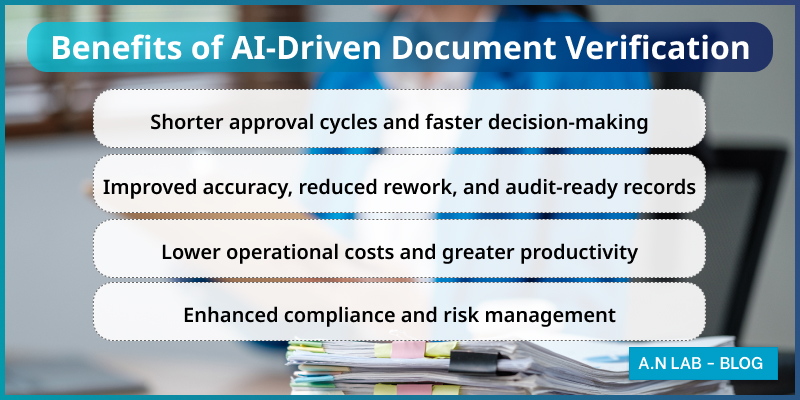
3.1. Shorter approval cycles and faster decision-making
Automation reduces review time from days to minutes. With AI pre-screening documents for accuracy and completeness, managers can make faster, data-backed decisions. This is particularly beneficial in industries like manufacturing and procurement, where delays in approval can disrupt production schedules.
3.2. Improved accuracy, reduced rework, and audit-ready records
AI verification systems detect even minor mismatches that humans may overlook – such as formatting errors, numeric discrepancies, or outdated document versions. This results in fewer revisions, smoother audits, and consistently high-quality documentation. Having AI document check systems in place also ensures version control, as each approval is recorded and traceable for future reference.
3.3. Lower operational costs and greater productivity
By cutting down on repetitive manual checks, organizations can allocate staff to higher-value activities. AI tools reduce the dependency on large verification teams, leading to lower labor costs and improved productivity. Over time, these efficiency gains compound – turning document automation into a strategic cost advantage.
3.4. Enhanced compliance and risk management
AI document verification strengthens internal controls and compliance. The system can automatically check whether documents meet regulatory or client-specific standards, ensuring consistent adherence across regions or subsidiaries. In highly regulated industries such as pharmaceuticals, banking, or insurance, this reduces the risk of non-compliance penalties and builds trust with partners.
4. Practical Applications of AI Document Verification
4.1. Finance
In the financial sector, AI-based document verification enhances customer service and ensures transaction security. It plays a vital role in preventing forgery and fraud during processes such as credit card applications or loan approvals. By verifying identity documents automatically and detecting inconsistencies or manipulations, AI systems help financial institutions build safer and faster onboarding experiences for their customers.
4.2. Legal Industry
In legal offices, AI automates contract risk assessment and compliance checks, improving efficiency in document review processes. AI analyzes contract contents in detail, identifies potential risks or inconsistencies, and highlights critical points that may require legal attention. This allows lawyers to focus on more strategic decision-making and reduces time spent on routine document checks.
4.3. Healthcare
In the medical field, AI contributes to the consistency and accuracy of patient records. By analyzing a patient’s past medical history and treatment records, AI can detect discrepancies or inconsistencies, supporting physicians in creating accurate diagnoses and treatment plans. This significantly reduces medical errors and improves patient safety and care quality.
4.4. Manufacturing
In the manufacturing industry, AI-driven document verification ensures product quality and compliance across production lines. Quality inspection reports, material certificates, and testing documents are automatically checked for completeness and consistency. For instance, AI compares inspection sheets against reference standards, detects missing or incorrect entries, and highlights discrepancies that may affect product quality. Through this automation, manufacturers can reduce manual verification time, minimize human error, and maintain consistent quality standards globally – ultimately strengthening reliability and operational efficiency.
5. A.N Lab’s Achievements with AI Document Verification
A.N Lab is a technology company with deep expertise in AI document verification solutions. Leveraging our experience in multiple industries, we provide innovative tools that improve accuracy, efficiency, and operational cost-effectiveness.
5.1. Document Checker
Our Document Checker can process 10,000–30,000 forms per day, significantly accelerating verification workflows. It reduces manual workload, minimizes human error, and ensures consistency across large volumes of documents. This solution has helped clients cut operational costs and improve throughput in industries such as finance, healthcare, and manufacturing.
References
5.2. Inspection Sheet OCR
The Inspection Sheet OCR technology automatically compares standard documents with target files, highlighting discrepancies clearly. It accurately recognizes handwritten, printed, and mixed character types – including Japanese kana, kanji, numbers, alphabets, symbols, and partially faded text.
This functionality enables fast detection of errors, missing information, or layout inconsistencies before production or approval. Enterprises can prevent costly rework and ensure compliance across all document-dependent operations.
Through these solutions, A.N Lab has successfully optimized document workflows across multiple sectors, providing high reliability while maintaining cost efficiency.
6. Conclusion: Smarter, Faster Business Operations with AI Document Verification
In an era of increasing data complexity and operational speed, relying solely on human verification is no longer sustainable. AI document verification and AI document check technologies transform how businesses manage accuracy, compliance, and efficiency across departments. By automating document workflows, organizations not only reduce costs but also enhance transparency, reliability, and decision speed.
As companies continue to adopt business process automation, AI-driven verification will play a central role – ensuring that every document, from contracts to production sheets, meets the highest standards of precision and accountability.
For companies looking to enhance efficiency and ensure document integrity, contacting A.N Lab is the first step toward smarter, AI-driven operations.