
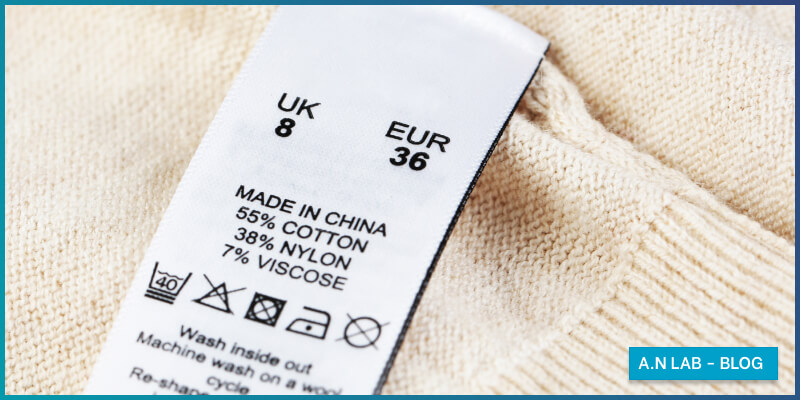
In apparel manufacturing, small printing mistakes on care labels can cause costly reprints and production delays. AI-driven label inspection and automated proof verification ensure higher accuracy, faster production, and consistent quality across every stage of the workflow.
1. Why Care Label Inspection Matters in Apparel Manufacturing
1.1. The importance of care labels in global apparel production
Care labels communicate essential garment care instructions and ensure compliance with international regulations. Accurate labeling reinforces brand credibility and consumer trust, particularly in global markets with diverse labeling standards.
1.2. Typical errors in label printing and proof approval
Inconsistencies between specifications and printed outputs frequently slip through manual checks, especially under tight production schedules. Common errors include misaligned layouts, incorrect symbols, and font mismatches, all of which can result in costly reprints or delayed shipments.
1.3. Why automation is the next step in quality assurance
Automation with AI-assisted quality inspection reduces repetitive manual checks and increases accuracy. Even subtle deviations from approved specifications are detected instantly, minimizing errors and accelerating the proof approval process.
2. From Design to Print: The Care Label Approval Workflow
2.1. Design data, proof creation, and print-ready files
The workflow starts with preparing design specifications, generating proofs, and creating print-ready files. Each step must be carefully validated to prevent downstream errors and maintain consistent quality across production batches.
2.2. Manual checking challenges and human error points
Manual inspections are time-consuming and prone to oversight, particularly for complex or multilingual labels. Inspectors may miss subtle differences between specifications and proofs, increasing the risk of rework and delayed production.
2.3. Impact of mistakes on brand trust and cost efficiency
Labeling errors can cause reprints, wasted materials, and delivery delays, negatively affecting brand reputation. Early verification and robust quality control reduce these risks and enhance operational efficiency.
3. How AI Improves Care Label Inspection
3.1. Automated detection of layout, symbol, and text discrepancies
AI-driven label inspection scans printed labels to detect misaligned text, incorrect symbols, and layout errors, ensuring every detail matches the approved design.
3.2. Comparing specifications with print proofs
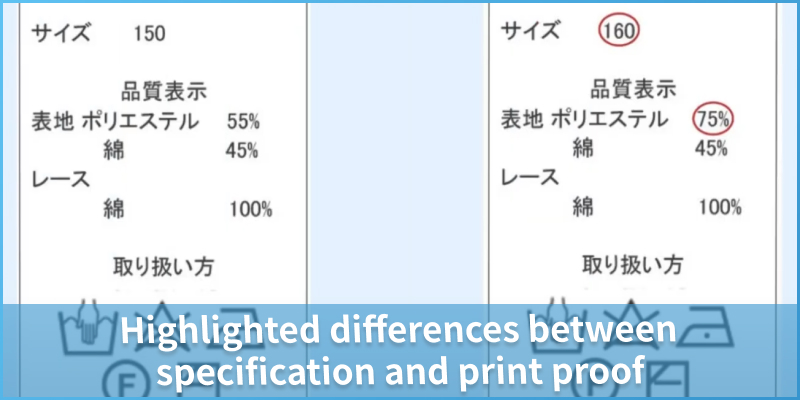
The AI system automatically compares approved design specifications with print proofs, detecting misalignments, incorrect symbols, or text errors before mass production. Early verification ensures costly mistakes are prevented, even in large-scale production.
3.3. Proof approval automation to prevent rework and delays
Detected discrepancies are summarized in an automated proof verification report. Manufacturers can quickly review and correct issues, accelerating approval cycles, reducing reprints, and avoiding production bottlenecks.
4. A.N Lab’s Design Checker Solution and Real-World Applications
4.1. Overview: Automating print-ready data verification with AI
Design Checker leverages advanced image recognition AI to verify print-ready data against approved specifications. It automatically detects layout, text, and symbol mismatches, minimizing human error and improving quality control.
4.2. How Design Checker identifies errors before printing
Each element – including fonts, symbols, spacing, and alignment – is compared between the specification and print proofs. Errors are instantly highlighted, allowing teams to correct issues before mass production begins, ensuring compliance and consistency.
4.3. Example Workflow and Case Study: AI in Action for Care Label Inspection
Manufacturers upload both the design specification file and the print proof into Design Checker. The AI compares all elements, flags discrepancies, and generates a proof approval report for quick review.
In real-world apparel projects, this workflow has reduced approval time by up to 70% while maintaining inspection accuracy above 99%. By catching errors missed in manual checks, it minimizes reprints, shortens delivery timelines, and ensures consistent label quality across factories.
5. Business Benefits of AI-Driven Label Inspection
5.1. Faster approval cycles and reduced production downtime
Automating Care Label Inspection significantly accelerates proof approval. AI-assisted inspection compares specifications and proofs instantly, allowing labels to be approved almost immediately. Faster approval cycles reduce production downtime, prevent bottlenecks, and enable brands to meet tight delivery schedules reliably.
5.2. Higher inspection accuracy and consistent output quality
AI consistently detects subtle discrepancies, including misaligned text, incorrect symbols, or minor font variations, that human inspectors may overlook. This ensures uniform quality across batches and multiple factories, strengthens brand compliance, and reduces the risk of rejected shipments.
5.3. Lower reprint costs and improved customer satisfaction
Errors in label printing often result in costly reprints, material waste, and delayed shipments. AI-powered label inspection catches these mistakes early by automatically comparing specifications with proofs. Brands benefit from lower production costs, faster time-to-market, and improved customer satisfaction, while maintaining high operational efficiency and consumer trust.
6. Conclusion
Integrating AI into Care Label Inspection allows apparel manufacturers to move beyond manual proof approval toward faster, smarter, and more reliable quality control.
Solutions like A.N Lab’s Design Checker empower brands to reduce rework, maintain compliance, and deliver high-quality labels consistently. For companies looking to implement AI-driven label inspection and automated proof verification, contact A.N Lab to learn how AI can transform your quality assurance workflow.