
Discover how AI Image Recognition and AI OCR are transforming manufacturing operations. From automated defect detection to real-time data capture, these technologies enable smarter production, higher quality, and seamless system integration for the modern factory.
1. The Rise of AI in Manufacturing
The manufacturing industry is undergoing a rapid digital transformation. As competition intensifies and quality standards rise, manufacturers are seeking smarter, more automated ways to ensure precision, consistency, and efficiency across production lines. Traditional inspection and data entry methods—once reliant on human eyes and manual paperwork—are now proving too slow and error-prone to keep up with modern demands.
This is where AI Image Recognition and AI Optical Character Recognition (AI OCR) technologies come in. By combining the power of computer vision and intelligent text recognition, these solutions enable real-time defect detection, automatic data capture, and quality control automation. Factories are becoming smarter, operations faster, and human resources can focus on higher-value tasks instead of repetitive visual checks.
In this article, we will explore how these technologies work, where they are being applied, and how they help manufacturers achieve smarter production and higher quality—two key goals of today’s Industry 4.0 era.
2. Understanding AI Image Recognition and AI OCR
2.1 What is AI Image Recognition in Manufacturing?
AI Image Recognition uses deep learning algorithms to analyze images captured by cameras and automatically identify patterns, objects, and defects. In manufacturing, it is used to inspect components, detect flaws, verify assembly, and even classify products by visual characteristics.
Unlike conventional vision systems that rely on strict rules, AI-based recognition can learn from data, adapt to variations in materials or lighting, and improve accuracy over time.
2.2 What is AI OCR and How It Complements Visual AI?
AI OCR converts printed or handwritten text into digital data. It is particularly useful for reading labels, serial numbers, and equipment meters, ensuring that production data is accurate and traceable.
When combined with image recognition, AI OCR creates a unified solution: cameras not only detect objects but also read critical text and numeric data—allowing for seamless automation across manufacturing workflows.
3. Key Applications in Manufacturing
3.1 Automated Defect Detection and Visual Inspection
Defect detection is one of the most common applications. AI Image Recognition systems analyze product surfaces to identify scratches, dents, or irregularities at speeds faster than human inspectors. This ensures consistent quality across all products, even at high throughput.
3.2 Barcode and Label Recognition for Traceability
Accurate labeling is vital for production tracking and compliance. AI OCR systems automatically verify barcodes, expiration dates, or part codes on labels. This minimizes errors during packaging and ensures traceability throughout the supply chain.
3.3 Reading 7-Segment Displays and Digital Meters
In factories, many machines display operational data on digital or 7-segment panels. AI OCR allows automatic reading of these displays—collecting machine data without manual transcription—and feeds it directly into MES or ERP systems.
3.4 Product Sorting and Quality Assurance
AI-based vision systems can classify products based on shape, color, or assembly accuracy. They automate sorting tasks that previously required manual checks, improving both speed and reliability.
4. Benefits of Applying AI in Production
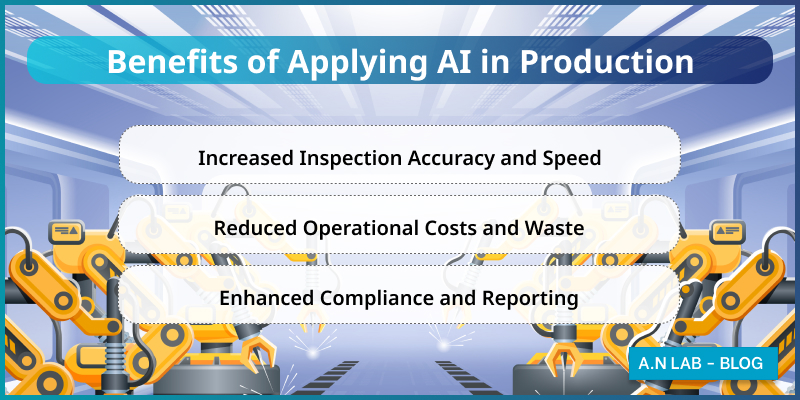
4.1 Increased Inspection Accuracy and Speed
AI systems operate continuously and consistently, reducing the risk of human fatigue or oversight. Visual inspections can be done in milliseconds per item, dramatically improving throughput.
4.2 Reduced Operational Costs and Waste
By detecting defects early, manufacturers prevent faulty products from advancing in the process—cutting rework, scrap rates, and warranty costs.
4.3 Enhanced Compliance and Reporting
Automated data capture via AI OCR ensures that inspection results, batch numbers, and quality logs are digitally recorded—supporting regulatory compliance and real-time auditing.
5. Integration with Manufacturing Systems
5.1 Connecting AI to MES and ERP Systems
AI Image Recognition and OCR solutions integrate with Manufacturing Execution Systems (MES) and Enterprise Resource Planning (ERP) platforms to synchronize inspection data, production status, and traceability information. This integration enables end-to-end visibility and data-driven decision-making.
5.2 Using Real-Time Data for Predictive Maintenance
Captured image and text data can reveal subtle patterns that predict when a machine may fail or require calibration. This supports proactive maintenance, minimizing downtime and maximizing equipment life.
6. Implementation Guide
6.1 Data Preparation and Labeling Process
AI models rely on large sets of annotated images. Manufacturers must prepare sample data covering various product conditions—defective, normal, different lighting, etc.—to ensure accurate model training.
6.2 On-Premise vs. Cloud Deployment
For sensitive production data, on-premise deployment offers full control. Cloud solutions, on the other hand, provide scalability, easier updates, and remote management. The choice depends on the manufacturer’s IT policy and data security needs.
6.3 Scaling AI Across Multiple Production Lines
Once proven effective on one line, the same AI model can be deployed across multiple sites or factories. Continuous feedback allows the AI system to improve over time, adapting to new product types and manufacturing conditions.
7. Conclusion
AI Image Recognition and AI OCR are no longer experimental tools—they are essential technologies driving modern manufacturing transformation.
By integrating intelligent vision and text recognition, manufacturers can achieve faster, more accurate inspections, digital traceability, and sustained production quality.
As industries move toward smart factories, those who adopt these AI technologies early will gain a strong competitive advantage—turning visual data into actionable insights that improve both productivity and quality.