
Let’s be honest — is your team still manually counting hundreds of products every day? That’s a huge waste of time.
With modern image recognition AI, object counting is no longer futuristic movie tech — it’s here, transforming real operations today.
From manufacturing lines to inventory tracking and retail analytics, AI-powered object counting is revolutionizing the way businesses manage quantity data.
In this article, we’ll explore five real-world case studies where companies successfully implemented AI to count objects, achieving not just efficiency, but unexpected business value.
- How AI Counts Objects: The Basics
- 2. 5 Practical Use Cases of Counting Objects by AI
- 2.1. [Case 1] Eliminating Human Error — Automated Counting of Roll Cage Carts
- 2.2. [Case 2] Preventing Delivery Mistakes — Automatic Item Verification
- 2.3. [Case 3] Counting Stacked Boxes in Warehouses
- 2.4. [Case 4] Visualizing Inventory — Counting and Classifying Packages Automatically
- 2.5. [Case 5] Tracking People, Vehicles, and Cargo Movement
- Conclusion
1. How AI Counts Objects: The Basics
1.1. Evolution of Image Recognition Technology
Over the past decade, image recognition AI has advanced rapidly thanks to deep learning. Algorithms like Convolutional Neural Networks (CNNs), YOLO (You Only Look Once), and Faster R-CNN now allow real-time object detection with accuracy exceeding 99%.
These systems can identify and count objects in images or video with incredible precision, even under complex conditions.
1.2. The Three Steps of AI-Based Counting
AI typically performs counting in three main stages:
- Detection – Identify each object and outline it with a bounding box.
- Classification – Determine what each detected object is.
- Counting – Aggregate the number of objects within each class.
Thanks to GPU-based parallel computing, these processes happen almost instantly, even for large-scale image sets. Advanced techniques such as data augmentation and domain adaptation also enable robust performance under lighting changes or object overlaps.
1.3. Manual vs. AI Counting: A Clear Advantage
| Criteria | Manual Counting | Count Objects by AI |
|---|---|---|
| Speed | Slow (human-dependent) | Fast (seconds to minutes) |
| Accuracy | Prone to human error | 95–99% accuracy |
| Fatigue Impact | Decreases precision | Constant accuracy |
| Scalability | Requires more staff | Easily scalable |
| 24/7 Operation | Impossible | Fully automated |
Especially when large quantities or continuous monitoring are involved, AI-based counting clearly outperforms human labor.
1.4. Cost and ROI
While initial setup (hardware, software, and AI training) requires investment, most companies report ROI within 1–3 years thanks to labor cost reduction, accuracy gains, and 24/7 operation.
In industries suffering from labor shortages, AI automation is more than cost-saving — it’s a strategic investment for business continuity.
2. 5 Practical Use Cases of Counting Objects by AI
2.1. [Case 1] Eliminating Human Error — Automated Counting of Roll Cage Carts
Challenge
At a logistics center, workers manually counted roll cage carts, leading to inconsistent and error-prone results.
AI Solution
Cameras installed on the ceiling captured real-time footage, and AI automatically counted the roll cage carts.
Results
- Reduced counting errors
- Standardized operations
- Significant improvement in work efficiency
2.2. [Case 2] Preventing Delivery Mistakes — Automatic Item Verification
Challenge
Workers manually verified whether delivered items matched invoices — a process prone to quantity and type errors.
AI Solution
AI analyzed overhead images, identified items by top-surface features, and cross-checked against delivery lists.
Results
- Fewer delivery errors and higher customer satisfaction
- Automated inspection and reduced work time
- Consistent quality in verification
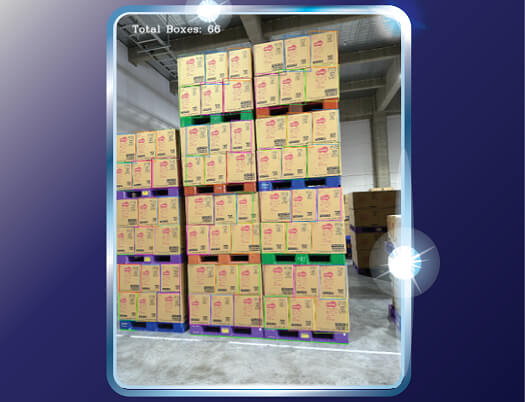
2.3. [Case 3] Counting Stacked Boxes in Warehouses
Challenge
Manually counting stacked boxes was difficult due to height and depth, causing frequent miscounts.
AI Solution
AI used camera footage and depth information to estimate total box quantity from visible patterns.
Results
- Reduced manual work
- Accurate counting even in deep or tall stacks
- Real-time inventory data
2.4. [Case 4] Visualizing Inventory — Counting and Classifying Packages Automatically
Challenge
Warehouses with diverse products struggled with time-consuming manual inspection.
AI Solution
Using image recognition, AI identified product shapes and labels, automatically classifying and counting each item.
Results
- Automated item identification
- Easier quantity management by category
- Reduced dependency on worker skill level

2.5. [Case 5] Tracking People, Vehicles, and Cargo Movement
Challenge
Factories couldn’t track human or vehicle movement efficiently, making it hard to detect bottlenecks or congestion.
AI Solution
Multiple cameras captured movement data; AI tracked people, vehicles, and cargo in real time.
Results
- Optimized traffic flow
- Early detection of congestion
- Improved safety and traceability
3. Conclusion
Counting objects by AI is no longer limited to tech giants — it’s now accessible for any business seeking to enhance efficiency and accuracy.
AI can perform tasks that humans simply can’t sustain — fast, precise, and 24/7. Integration with drones and robots will soon expand its capabilities even further.
Many companies have already replaced “human eyes” with AI vision — achieving a new level of operational intelligence.
If you’ve ever thought, “Could this work in my workplace?” — the answer is yes, and now is the perfect time to explore it.